Himalayas
The Eight Mountains: A NovelThe Himalayas are more than the setting for Pietro’s mountaineering assignment: they are the destination his lifelong attachment to mountains has prepared him to seek, and a living landscape that changes what he wants to observe. Traveling toward Annapurna, he finds a world of glaciers, rivers, terraced fields, and working villages. The encounter turns his attention away from summits alone and toward the people whose lives are shaped by the mountain valleys.
A destination rooted in Grana
Pietro explains his interest in the Himalayas through the mountain where he grew up. In conversation with an elderly Nepalese man carrying a cage of live hens toward a refuge below Everest, he says that his childhood mountain fostered his desire to see the most beautiful mountains in the world. The man recognizes this attachment as a journey among eight mountains. The exchange makes Pietro’s Himalayan travel part of a longer relationship with mountains, rather than a sudden departure from his earlier life.
That relationship began in the Alps. At thirty-one, living in Turin after leaving Milan, Pietro still felt that seeing the mountains on the horizon when he left his apartment was a blessing, even though he had not returned to them. His later journey toward the Himalayas extends this divided existence: he can leave his birthplace and travel far, but the mountains remain a point of reference. In Nepal, the childhood landscape is not physically present, yet it helps explain why these distant ranges matter to him.
The approach to Annapurna
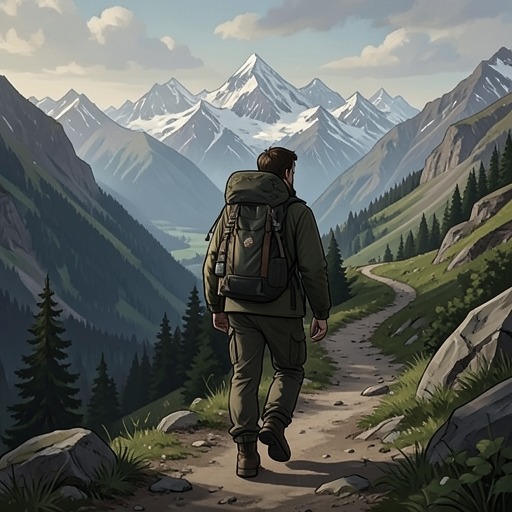
On his first journey to Nepal, Pietro travels with four Italian mountaineers toward Annapurna. He shares a tent with them for several weeks and carries a film camera for a well-paid assignment to make a documentary about mountaineering. Initially, he is intrigued by the chance to see how the group will behave under extreme conditions. As the expedition approaches base camp, however, the journey itself becomes more compelling than the project’s original focus. He decides to stay in Nepal after the expedition and travel independently through lower-altitude regions.
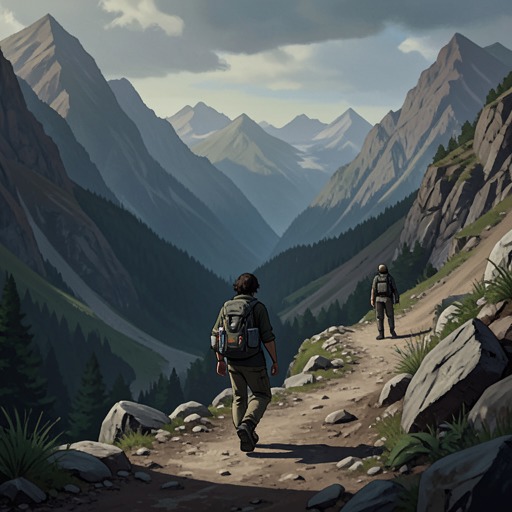
The approach unfolds through a valley less than two hundred kilometers from Kathmandu, reached after a day’s drive. A river runs below the route, often audible but out of sight; villages stand higher on softened slopes and connect by steep mule tracks and narrow rope bridges. Around them, terraced fields and rice paddies divide the mountain into small plots, bordered by low dry-stone walls. In October, the harvest is in progress: women kneel in the fields, men beat grain in village yards, and older women sift rice spread out on cloths. The route gives Pietro a sustained view of work and settlement, not merely a passage toward the climbing ground.
A lived mountain landscape
The villages evoke for Pietro an older agricultural world, but one that remains active rather than preserved as a ruin. He notices wooden plows, river stones used to sharpen scythes, and wicker baskets carried by porters. Trainers, radios, and televisions are also present, reminders that this is not an untouched past. What strikes him is that traditional tools and contemporary objects coexist in communities that are still functioning. Along the route he sees no derelict buildings, a marked contrast with the abandoned structures he associates with the mountains of his own country.
On the second day of walking, at the end of the valley, the Himalayan summits appear. Their scale and sharp outlines make them seem newly formed, as if they have not yet been worn down by time. Snow at elevations of six or seven thousand meters lights the valley from above. Waterfalls plunge from overhangs; landslides of reddish earth break from ledges and tumble toward rivers; glaciers overlook the movement below. For Pietro, the scene gives visible force to the connection between high mountains and the water used in the valley. Annapurna’s name, associated in his account with the goddess of harvest and fertility, also brings the mountain into relation with the cultivated land below it.
That attention to the valley distinguishes Pietro from the climbers accompanying him. They are impatient to leave the villages and begin climbing on the ice, while he walks among the porters, asking about crops, firewood, and the small shrines along the route. He notices that the forests contain neither fir nor larch, but tall, contorted rhododendrons, the favorite flowering plant of his mother. The detail brings a familiar family memory into the unfamiliar landscape without making Nepal a substitute for home: the rhododendrons are recognizable, but their size and setting are new.
Beyond the expedition
The documentary assignment becomes a point of departure for a more personal project. Pietro tells Bruno that he has obtained enough funding in Milan to stay away for at least a year and intends to travel through the regions of Nepal, portraying the distinct peoples who live in the Himalayan valleys. He expects to leave in October, near the end of the monsoon season. Although he has little money, he has contacts who can help and provide lodging. He has given up his home in Turin and is prepared to remain in Nepal longer if the work goes well. The plan extends the shift already made on the approach to Annapurna: from observing a climbing party under extreme conditions to attending to mountain communities and their different ways of life.
The Himalayas therefore enter Pietro’s story through both movement and memory. They are the distant ranges he once wanted to see because of his attachment to Grana, the imposing high-altitude world reached on an expedition, and the setting for a possible life and body of work beyond Italy. Yet Pietro’s attention repeatedly returns from the high summits to the valley—its water, farms, paths, porters, and villages. The location’s significance lies in that change of scale: the mountains first draw him onward, then teach him to look at what lives beneath them.